In the shifting landscape of contemporary fashion, where the boundaries between disciplines continue to dissolve, Tomihiro Kono emerges not merely as a hair artist but as a sculptor of identity. His practice transcends hairstyling, repositioning hair—often overlooked as a supplementary element—into a primary medium of artistic expression.

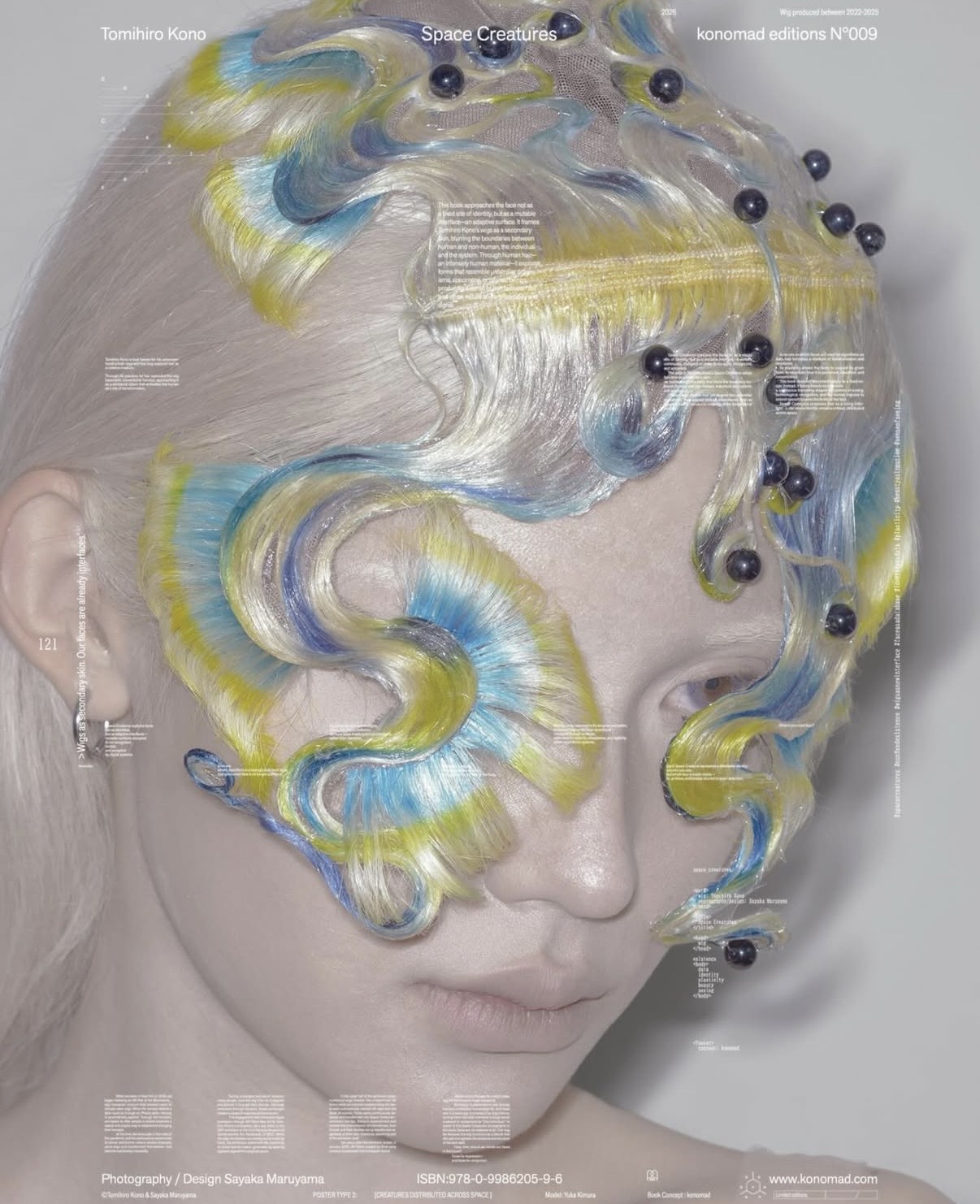
Kono’s work resists conventional categorisation. Crafted exclusively from human hair, his wigs abandon their original material logic, evolving instead into autonomous forms that oscillate between the organic and the otherworldly. They exist simultaneously as adornment, mask, and artefact—objects that do not simply frame the body, but reconfigure it.


Operating at the intersection of fashion, art, and performance, Kono has established a distinctive visual language rooted in transformation. His creations frequently draw from nature’s most elusive forms—deep-sea organisms, fragile moths, or moss-like textures—translating them into hybridised, speculative identities. Through this lens, the human figure becomes a site of mutation, a canvas for imagined species that challenge fixed notions of self.

This conceptual direction finds its most articulated form in Fancy Creatures, a body of work that expands the possibilities of hair into a realm of speculative design. Here, Kono proposes a radical rethinking of embodiment: hair is no longer decorative, but evolutionary. It becomes a mechanism through which the wearer negotiates visibility, identity, and transformation.

Central to his practice is the idea of longevity—an intentional departure from the ephemerality of fashion imagery. Unlike traditional hairstyling, which exists momentarily within the temporality of a shoot or runway, Kono’s wigs are designed as enduring objects. They can be reconfigured, exhibited, and archived—existing beyond the body as independent works of art.

His collaborations further reinforce this expanded position. Working with figures such as Björk and institutions across fashion and contemporary art, Kono situates his work within a broader cultural dialogue—one that interrogates beauty standards, performance, and the fluidity of identity. His pieces do not complete a look; they destabilise it.


Yet beneath the experimental surface lies a deeply human intention. Kono’s work ultimately centres on the individual—the wearer as subject rather than object. Each piece becomes a tool for self-articulation, allowing individuals to project their internal narratives outward and be seen as they imagine themselves.
In this sense, Tomihiro Kono does not simply design hair—he constructs possibilities.